Welcome to my website. Dedicated to those who pursue all that is impractical, illogical and immoral, and flying, which sometimes all go hand in hand.
This current website is the third “restatement” of an earlier site first published in 2009. That site, put together with an obscure piece of software long since extinct, consisted of a random collection of photos and not much else, devoid of a theme or purpose. My first choice in 2016 was to continue to modify the old site, but upon losing the administrator password I learned that even the best of the best at GoDaddy couldn’t revive the failing patient; the old site was toast and the new one emerged from the ashes on August 4, 2016. It was again restated in 2019 and again in 2025. Actually the restatement in 2025 was not a restatement as such but after 16 years I finally decided to make it more friendly to being indexed by Google and maybe someone will actually discover it in an internet search. Who knows what will come of this.
I learned to fly with the understanding that I would never use it for anything useful other than having fun; I have not been disappointed and with this site, I will recount some of the more memorable moments. Why?
Damned if I know.
–dan, circa 2009, and 4Aug16 and 15Jul19 and 30Nov25
Just Charge It – Part 3
The avionics work was finally finished and the plane was ready to go but it wasn’t. January can usher in strange weather to southern California via the Santa Ana winds and, indeed, 2026 brought some really windy weather. So I waited to pick up the plane; and I waited and waited and waited until I couldn’t wait any more. I called Hertz for a one way car rental from Palm Springs to Santa Paula and they were out of cars; the same was true with all the rental car companies. Nothing was going to be easy about this.
So once again, off I drove in my U-Haul rental truck bound for Santa Paula. On the trip up to SZP I kept watch on the weather looking for signs that the winds were easing; some spots were dead calm while others were still blowing up a storm. But when I arrived in Santa Paula the weather was beautiful and despite receiving a warning from flight service about moderate and occasional severe turbulence, off I went. I wasn’t in the air for five minutes when it began to get bumpy and the plane was kind of doing its own thing but nothing beyond what I would call moderate turbulence. This would not be so bad after all.
But along about Ontario I ran into some unexpected clouds that appeared at first to be a rather large wall of them. All stations were reporting VFR weather between me and PSP so I decided to drop down and get below it. But after dropping about 1000 feet I changed my mind ( I know not why) and decided to climb above it and advised ATC of my intentions; they pretty much told me to do whatever I needed to do but they sounded a little concerned; perhaps I sounded the same. 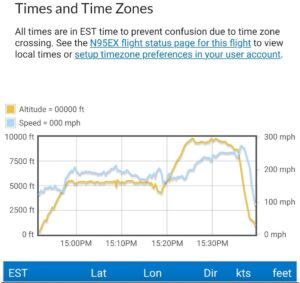 After hearing several reports from several pilots reporting severe turbulence I advised ATC “I’m at 9500…let’s see what happens”. And it wasn’t too bad. With the tailwind I picked up going through the Banning Pass, the ground speed really picked up so I was through the worst of it pretty quickly. The winds were gusting over 30kts at PSP but straight down the runway and I aced the landing; all-in-all it was really a hoot.
Avionics Upgrade: “Just Charge It”, Part 2
So I dropped off the rental car in Ventura and arranged for an Uber to take me to SZP to pick up the plane after the annual and the magneto issue were resolved. It was a beautiful day in early November and still before noon; I would be back st PSP with lots of daylight left to spare. Things were going great: the weather was perfect and the plane was likewise; what more could you ask for?
I spoke with Ray for a bit, gassed up the plane and off I went. I hadn’t been aloft for 5 minutes when I noticed the radio display turning opaque; this was not a serious event and happened about every 6 months; a simple adjustment of the brightness and contrast settings would return things to normal. I adjusted the settings, the radio display looked perfect and the rest of the flight was superb.
It had been about a month since I had taken the plane to Santa Paula and I was eager to put some hours on it. So the day after I returned from Santa Paula, sunrise found me at the hangar ready to take the plane out and otherwise just fool around. With the new battery, the engine sprung to life as soon as I cranked it over. But, oddly, once again the radio display turned opaque and once again I had to adjust the display settings. The seeds of doubt were planted.
The radio issue was not any small concern; although the adjustments to correct the opaque display were simple enough, the cause of the problem was not. The Garmin 430 radio is likely the most popular radio ever introduced for general aviation, but the technology is roughly 30 years old and Garmin is no longer supporting the product; you can’t blame them; you won’t find very many people supporting the IBM 386 line of computers either and those hail from about the same era. The crux of the problem is that Garmin has run out of replacement displays, and when the display is failing, it can become impossible to read the frequency settings at which point it is useless even though the radio itself is still working normally. My internal yellow caution light was shining bright.
So off I went, my mission now being to determine if the display issue was indicative of something serious or just a freak event. I flew it for about an hour, landed, refueled and flew for another hour. Everything look fine so the internal yellow caution light dimmed. But the following day I repeated the exercise and, again, the display was all wacked up when I first started the plane; and again I spent the next two hours flying the plane to see how the radio acted. Two hours of flying and the everything performed flawlessly; I may have been a bit rusty but I even managed to get in some basic aerobatic maneuvers; O.K., I may have been a lot rusty. But the objective was to give the radio a workout and it performed flawlessly.
And then I landed.
As I idled the engine while parked in front of the hangar, the radio display turned 99% opaque; it glowed a bright yellow hue. And all the king’s horses and all the king’s men couldn’t put the display back together again; it was gone. But as I stated earlier, the radio communication functions still worked….as long as you knew the frequency setting. Fortunately, I soon discovered that I could see just enough of the display settings to make out the frequencies; but this information, i.e., the frequency settings, could only be discerned when standing outside the plane and looking at the display at an extreme angle; it could not be seen when looking at the display “head on” as when you are when seated in the pilot’s seat. So I managed to set the frequencies as follows: the active was set to PSP tower; the standby was set to SZP. And the following morning off I went, fat, dumb but not very happy on my way back to SZP.
And that’s when the next gremlin reared its head. It seems like whatever was ailing inside the black box was now causing it to reset, i.e., reboot about every three to four minutes; the radio would completely shut down and restart so that even the com portion of the radio was gone momentarily. Although I didn’t particularly care about not having the radio live while en-route, I was not 100% certain (in fact, I was not at all certain) that the radio was resetting to the correct frequency when it restarted; I was not ruling out the possibility that the radio would be totally screwed up and I would need to enter the traffic pattern and land at SZP without a radio; I was not overjoyed with that prospect.
Somewhere near Burbank I switched to what I hoped was SZP on the radio, and waited. Fortunately, the radio soon came alive with chatter from some unknown pilot of a plane departing SZP and I breathed a sigh of relief and the rest of the trip was a non event.
And then I discussed with Ray the options for replacing the radio and GPS and later he gave me an estimate of the total cost. Ugh. Oh well.
Just charge it.
Ignition Retrofit: “Just Charge It”
One rule of thumb that has served me well is that batteries should be changed every five years, period; and this rule I’ve applied to cars, motorcycles and airplanes. But, as the man says: “Rules are made to be broken.”
Some of my equipment–the plane, one motorcycle and the Airstream–reside in the desert year round and heat is brutal on batteries; and they all failed in 2025; none made it five years. In the case of the motorcycle and the Airstream changing the batteries was not a big deal; of course, nothing is cheap anymore but the effort involved to make changes was minimal.
But, oh, when it came to the Extra…….. the Germans have totally rewritten the book on complexity. For whatever reason, the battery is mounted ahead of the front seat rudder pedals, in between the main landing gear struts. And it is absolutely impossible to get the battery out to replace it without a major disassembly of the plane: read that to mean approximately a full day of labor (and that is not MY labor, it the is labor of someone at Ray’s Aviation who knows what he is doing).
I began to notice the Extra’s battery showing signs of stress along about last July; it just didn’t seem to turn the engine over quite as quickly as it did when it was younger and now frequently got “stuck” on the engine’s first compression stroke. But with the annual coming up in December, I was sure that all was OK and the battery couldn’t possibly fail before them. But the symptoms were getting worse with each turn of the magneto swith, but I forged ahead, confident that somehow the battery would make it until December. But the summer heat was brutal and the battery was failing fast. October rolled around and the writing was on the wall: the battery wouldn’t make it til December.
I’ll skip the usual drama associated with all the little details that pop up when time to ferry the plane to SZP. Suffice it to say that all went well for the short trip. Because of the complexity associated with gaining access to the battery, in particular, the amount of the fuselage disassembly required, we decided to go ahead and annual the plane in October rather than do the whole disassembly process again in just two more months. (I learned later that it was actually necessary to remove the header fuel tank in order to get the battery out.) Ever the optimist, I knew that since there was nothing else wrong with the plane, the rest of the annual would be a simple process.
Wrong.
It wasn’t long before I heard the news: Ray found that the engine was running rough and he suspected there was something going on with the electronic ignition half of the ignition system. I just don’t notice things like rough running engines. But, we agreed that Ray would continue the exploratory work to see if the source of the problem could be isolated and, hopefully, fixed; but, after a couple of more days of this, there was no such luck. The final decision came down to removing the electronic unit and either (1) returning it to the manufacturer for further testing or (2) just replacing the electronic unit with the original magneto that Ray had removed and, fortunately, saved from two years before when the electronic unit was first installed; I voted for option #2 and it was wildly successful. Even I noticed how much better the plane was running.
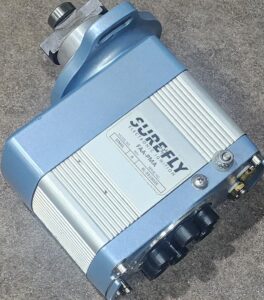
Makes A Great Paperweight
Of course, the cost of what I thought was going to be a rather routine annual greatly exceeded what I had mentally budgeted; but those things happen; after all, this is a plane we are talking about. But on the bright side, I ended up with: a plane that was running much nicer, a world class electronic magneto that would now serve as a world class paper weight AND a new battery that would like be good for the next four years; and, all I do for all of this was just charge it.
The Annual Annual Ritual
For most folks here in the USA, November is a festive month as it signifies the start of a long holiday period leading up to the new year; but, that has not been the case for me for the last several years. For me, November signifies the start of the planning process to get 95EX from Palm Springs to Santa Paula for the annual annual which has been falling in December for the most part for the last few years. Now the actual flight from PSP to SZP is really quite short; its only about an hour plus or minus depending on when you start and stop the timer. But given competing holiday time demands, sundry commitments, uncertainty of the weather and time constraints at Ray’s Aviation, it always seems the trip is a pain in the ass.
And the process in 2024 had a few extra (Extra?) twists. Generally speaking, 95EX has been relatively easy in the maintenance cost department but this year had interesting twists. The first gremlin literally “popped” up in the intercom: it seems that the intercom circuit breaker popped every now and then (but not a big deal because I rarely fly with anyone in the front seat) but when it popped I couldn’t transmit on the comm radio and that WAS a big deal; and, to me, all of that meant it was time for a new intercom!  Next to occur was the leak in the brake fluid lines. I learned that the early Extras had a brake system that has been replaced by an newer system that is more reliable in this department and Ray convinced me to “upgrade”. And then there was the perennial oil temp gauge indication that would mysteriously drop to zero while flying and would just as mysteriously return to normal when the strobe or position lights were turned on (I couldn’t make this shit up!): time to rip out the entire old analog oil temp affair and replace it with digital equipment to match the digital tach!
And to top it all off, I managed to strip the bolts on not one but BOTH wheel fairings which made it impossible to get the fairings off to put air in the tires and this was the last straw: I called Ray in mid November and had 5EX up at SZP the week before Thanksgiving and fully expected not to see it for a month but that was OK.
But Ray got busy and my pre XMAS social commitments began to pile up so the next logical conclusion with Ray was to see each other “next year”. My plan was to rent a car for a one way drive from Palm Springs to Santa Paula, stay the night, pick up the plane early the following morning and then fly it back to PSP like I had done many times in prior years. But I didn’t take into account the film festival in Palm Springs and the added demand created for Palm Springs rental cars; there were none available at any price let alone for a “one-way” rental. Undaunted, I soldiered ahead and considered Uber but settled on a 15′ UHaul truck and headed west toward Santa Paula on Sunday, January 5. The weather forecast was good but with little room for error: high winds were forecast for Tuesday but so long as nothing popped up requiring additional attention on the plane, all should go well. Monday emerged as a fabulous day: crystal clear skies over the entire LA basin and little to no wind and 95EX ended up at home. January 2025 was off to a good start.
Unfortunately many others were not so lucky: the weather forecast was spot on and the winds were fierce on Tuesday. And something sparked a fire in LA.
You Can Never Go Home Again: A Flight Back To PIH
For years I have reminisced about my brief time living in Pocatello, Idaho, and have thought about going back just to look around. So last month I decided to go take a look.
I couldn’t have picked better weather: crystal clear skies, not too warm and the winds, both on the surface and aloft, were dead calm; that combination made the ride as smooth as silk.
The trip was relatively short-a little over 4 hours including one stop for fuel in Cedar City, Utah. But the scenery was amazing: red rock mountains, fall colors, the Wasatch Mountains and the Great Salt Lake.
Even though it’s been 35 years since I last flew out of PIH, the basic airport layout hasn’t changed. But somebody has spent a lot of money on airport improvements: a new tower; lots of modern new hangars, acres of well paved and well maintained ramp space and lots of planes on the ramp including several business class jets.
And of course I had to get into a car and drive past the old house. Although the house still looked great with a new roof, new siding and lots of landscape changes, the neighborhood itself looked kind of tired and that was a bit of a letdown. Oh well, at least I finally made the trip.
I grabbed a sandwich at the grocery store and checked into the Motel 6. The following morning was cold, really cold, but I gassed up the plane at the crack of dawn and retraced the route back to Palm Springs.
Crossed one more item off the bucket list.
2024 Update. Moving Up To the Extra 300L
My how time flies. It has been well over three years since I have updated here. And a strange three years to say the least. From living accommodations to personal health issues, it has been quick the epic three years indeed. Fortunately, the laws of aerodynamics are constant. Of course I didn’t intend to be this stagnant for so long but I had some outside help. Once again, mysteriously, I could not get WordPress to do what it was supposed to do and all progress halted. I finally threw in the towel, called GoDaddy and paid $$$ to have an “expert” in some remote part of the world fix whatever I had managed to screw up. So I am back in business.
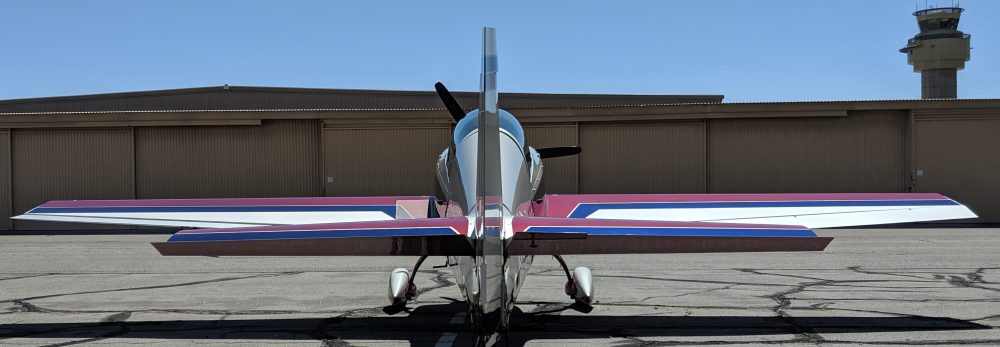
My first order of business is to post a couple of picks of my latest ride–an Extra 300L–by far the greatest plane that I have ever owned or flown. It is the best of everything: it’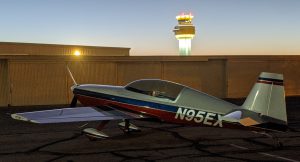 s fast, it carries a decent amount of fuel, it lands easy and it is roomy….at least in comparison to anything else that I have flown. And so far I have not been beleaguered by exorbitant maintenance and repair costs. So far. And I have not bent or broken anything. So far.
We are still based in Palm Springs and the longest trip to date has been to Denver and that was a hoot. The photo above was taken right before departure at about 6:30 am local time in Palm Springs and I was putting the plane about 4 1/2 hours later in Denver and that included a fuel stop in Gallup, New Mexico. Weather was ideal and the service I got from Signature Flight Support at Rocky Mountain Regional was amazing and much better than I am used to getting elsewhere.
But the return trip was when things really got interesting. I have not spent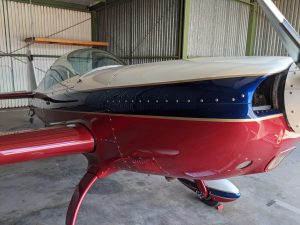 a great amount of time flying near the clouds. With the range afforded by the Extra, more time needed to be spent paying attention to the weather than it had been in the past….at least it should have been spent. Leaving Gallup on the return trip home I could see from the flight app on my cellphone that there were cloud buildups both to the north and the south but it looked clear along my direct route. So off I went, fat, dumb and happy as the saying goes. Midway through Arizona the clouds were getting lower. And closer. But I soldiered on like I really knew what I was doing. To make a long story short somewhere in western Arizona I found myself almost totally surrounded by clouds and it was not a pretty sight. Summoning up my best rendition of Chuck Yeager sounding cool and collected I said to the controller that I had been in contact with: “If you were going to give me a heading to get me out of this mess I find myself in, what heading would you give me?” The controller responded with something like: “fly heading 135 degrees” just as the radio was acting up and I lost contact with him. Shortly thereafter another pilot on the same frequency told me to switch frequencies and contact LA center. I had no sooner set the frequency when I heard a gal from center calling out to me; about the same time I broke out into clear blue skies all around. Fun trip.
I will try not to be a stranger going forward.
One Hot Airplane & A World Record Holder As Well
Alas. Time flies. And you know what they say about the best laid plans. I started this post over two years ago and then…..life happened. And even though things have once again taken a MAJOR change, I decided to go ahead and finish this post before trying to catch up to the present. Had I have pursued this post and completed it when I first started, it surely would have been more lengthy as the events would have been clearer in my mind. But I will soldier on and give it my best shot.
* * * *
The Sunbird Saga: From Beginning To End
I am a Virgo and have been told that Virgos tend to analyze things to death. While I generally don’t believe in all of that astrological hoopla, I DO tend to seek out gobs of data when moving into something new. My gut told me that even though the Sunbird was a “Pitts”, it somehow was substantially different than anything that I had flown and I needed to find out exactly what those differences were all about. Only one man alive had flown the Sunbird and that was Spencer Suderman. Spencer had overseen and bankrolled the restoration of the Sunbird in anticipation of using it to set a new world’s record for inverted spins. Spencer’s help was priceless; we spoke by phone; we exchanged emails; we covered everything from start-up to shut down; and to me I saw LOTS of subtle differences between the Sunbird and anything else that I had flown. But I had everything covered; at least that is what I thought: rudder pedals, equipment, fuel transfer…..everything…..or so I thought.
After amassing pages of notes from my conversations with Spencer and pouring over all of the manuals for the avionics installed, I headed off to New Mexico to meet Fara Green, a delightful lady and the widow of the Sunbird’s builder, Dick Green, and to pick up the Sunbird. The first order of business was to jump in the plane and see first hand all of the things that Spencer and I had discussed in such great detail. Everything was exactly where it was supposed to be and worked as expected; there was nothing to do except fire it up and see how it handled. So off I went; I fired it up and taxied out of Fara’s hangar attached to her home. And that is when I ran into, almost literally, my first problem: the damn thing wouldn’t turn. No matter what I did, no matter how far I pushed on the rudder pedals, the plane would simply not turn. I ran off of the taxi way at least twice and almost ran into a post before I got on the phone with Spencer. It seems that we forgot to discuss the tail wheel which was a free castering device that can only be steered, and just barely, by differential braking. It took a fair amount of practice for the rest of a very hot afternoon. And when it is 105 degrees in New Mexico, it is hotter than hell inside a single place biplane with no air vents and a bubble canopy.
The hospitality extended by Fara was unbelievable but the time came to leave; I was heading into what proved to be the hottest week of the year throughout the southwest. Morning came, the take off was routine and I was on my way. Now I had several concerns but on the top of my list was fuel: the Sunbird doesn’t hold very much. So, my first leg was relatively short so I could top off the fuel. Ultimately it would take six fuel stops to make it home. My next concern was landing: despite Spencer’s reassurance, I wanted to see just how this thing handled from power back to shut down. That first landing was a non event. Thanks Spencer. But the trip back to San Luis Obispo had other obstacles: I was sick and it was hot. I don’t recall what medication I was taking but I am sure that the FAA may have raised an eyebrow or two. And the heat was unbearable. My plan was to fly only in the morning to avoid the hottest part of the day but on the second day it was already 115 degrees when I landed in Palm Springs and it wasn’t yet noon; that day topped out at 124 degrees. But make it home I did and without breaking or bending a thing, including my ego. In fact, I was pretty jazzed about it for several days.
Over the next several months I accomplished a lot, including getting rid of that ridiculous tailwheel. A trip back to Ray’s Aviation resulted in adding a big 3 bladed MT prop and a steerable tailwheel. Then there was a fair amount of time in the pattern learning how to cope with the incredible sink rate with the extra weight and braking effect of that large prop, but I eventually got there. Over time, I traveled with the Sunbird throughout California and into Nevada and Arizona. Given the fuel situation–that is, the lack of a reasonable amount of fuel–I normally flew with the power pulled back. But because the plane was so light and the engine and prop so powerful, I still could cruise at 150 MPH when the engine was using slightly less that 11 gallons per hour.
The Sunbird was built to fly, not to be worked on by a mechanic. It seemed like even some of the simplest things if done in a certified Pitts proved to be a challenge on the Sunbird. Thank God I had access to Ray; it would have been impossible without him. The engine compartment was especially challenging: there was virtually no access to  many of the areas on the accessory case. If the day ever comes when the electronic ignition goes out, the engine will have to be pulled.
One hot Saturday in July, 2017, found me topping off the tanks in Thermal, California, after a 10 – 15 minute flight from my home base at Palm Springs. (I like being based in Palm springs where KPSP is only a mile and a half from my house. But at $7 a gallon for 100LL, I usually fueled up elsewhere until I learned that the FBO at PSP was supposed to be giving me a sizable credit for being a tenant. Once we got that credit situation straightened out, things got more friendly.) While taxiing away with my now full fuel tanks, the radio came alive with this simple message from a stranger: “Hey Pitts, you’re leaking oil like a sieve”. Even though I managed to kill the  engine in record time, I had already lost all but about 2 to 3 quarts of oil. It took over a month of down time, two oil lines and an oil cooler to get the Sunbird back in the air. Once flying, I headed straight to Santa Paula and once again Ray was able to fix the cause of the problem and not just patch up the symptoms. So now the oil cooler had been repaired yet again and the engine sported a new and smaller starter and relocated starter solenoid; that finally put an end to the oil issues.
Even though the fuel situation could be managed to allow for travel from Point A to Point B, travel was tenuous at best: it was hot and it was small and much to my surprise, I really missed the 2nd seat. So, once again, I started thinking of selling. But this time, when I eventually listed the plane, I discovered that the sale would be anything but easy. In fact, it was a bitch and a real pain in the ass. I am not saying that all of the prospective purchasers were scavengers; they weren’t. One really fun guy from southern California really loved it and didn’t balk at the asking price (at that point I was still asking only about 85% of what I had paid into purchasing it, not including repairs); but he was sooooo big that he could barely move once he wedged himself inside. Life sometimes can be cruel. But sell it did and I moved on.
And I came down with mono.
Nothing Lasts Forever
So now I was the proud owner of a freshly recovered S2B and life was good. And then came April, 2016.
Now I have not subscribed to Trade-a-Plane in years and really wasn’t at all interested in looking at it. But once in a blue moon, I would come home and there would be a complimentary copy sitting on the counter; and, that is what happened in April, 2016. I reached to pick it up and throw it away, but instead set it on the counter and it opened almost by itself. Now there are never many, if any, Pitts for sale but the paper just happened to open to the page with the listings for Pitts. And there, right in the middle, was a simple one column inch ad for the Sunbird. The Sunbird! I read about this plane ten years before and had always thought, “That is what I would really like to own.” I poured over that ad and thought about it all night and the next day I started making phone calls. I spoke with the broker (who at the time was in Norway), and then with the only man alive who had flown the plane, and then mechanic who had recently refurnished it and, finally, the owner. It was a slippery slope and I was going down fast.
So what was it about that plane that got me so Jazzed? I have always gravitated to the unique and unusual and the Sunbird fit that description to a “T.” It’s registered Experimental, Amateur Built, with a design based on the Pitts S1. Although its outward appearance is similar to the Pitts S1, under the cowl is a Lycoming IO540 generating at least 30% more horsepower found in the average S1. Its a single seat plane, whereas my S2B had two seats. Hell, most of the time (read that 95%+) I was alone when I flew the S2B so I figured having only one seat was not a big deal.
There are common threads that bind much of my experience with aviation. The Sunbird was designed by Dan Rihn, the designer of the Phoenix; the Phoenix is owned by John King who first checked me out in my first Pitts. The Sunbird was recently rebuilt by Ray’s Aviation who had just recovered my current Pitts. It didn’t take long to find out a lot about the Sunbird and I decided to buy it. The owner, Fara Green, is a delightful lady and was a pleasure to deal with; we struck a deal and I sent off a non refundable deposit. If I couldn’t sell the S2B in six weeks I would either (1) lose the deposit or (2) pay cash for the balance and own two planes until I could sell the S2B; and, neither one of those options appealed to me.
S2B was out up for sale and potential buyers came out of the woodwork, lots of nice people from all over the world; it sold in a heartbeat.
Another adventure was about to begin.
N6034S The Aftermath
So now I was the proud owner of a fabric covered plane with a ginormous hole in the fabric and I didn’t have a clue as to where to start. Well, actually I did know where to start: the insurance company. After just a couple of phone calls an insurance adjuster was scheduled and would arrive in a matter of just days. Fortunately my paperwork was all in order. Then, there was my local A&P–Al at Air San Luis. 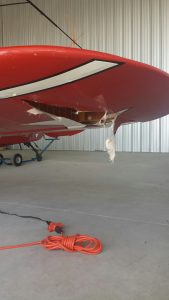 Al was a Godsend; without him, I would have been lost. Without belaboring all of the details, we decided that Al would put a temporary patch on the hole, obtain a ferry permit and I would take the plane to Ray’s Aviation in Santa Paula for a permanent patch for the wing. Actually, “we” didn’t decide anything; Al pretty much told me what needed to be done and that was the way it was going to be.
As far as “plans” go the one described above seemed straightforward and I was encouraged and just assumed that the repairs would be started quickly and would be complete in short order. The plan started on schedule but went south quickly. The first thought was just to use duct tape to make the patch. But the hole was so big that the weight of the duct tape pulled the patch from the bottom of the wing–there wasn’t enough clearance behind the aileron to go completely around the wing with the tape. Plan B involved sanding down the paint ant applying a fabric patch; this too should have been a quick fix but for the fact that the weather turned unseasonably cool and the bonding goop that Al wanted to use required warmer weather. So we waited. Eventually the weather warmed and now, nearly two months after the unfortunate occurrence in Reedley, the plane was taken down and handed off to Ray.
But Ray was in high demand; remember this is now in June. Ray’s Aviation does a LOT of work for guys with aerobatic planes and once again I had to wait until Ray had the chance to start on the project. At this point the project had expanded to a complete recovering of the bottom wing which the insurance company would pay for. The only thing that I would be paying for would be modifications to the lower wing attach points to remove an AD. But just as the work began another landmine exploded: Ray indicated that the fabric on the whole plane was shot; it didn’t need a punch test, the fabric could be torn like tissue paper with your bare hands. I knew this day was coming–the plane still sported the original cotton fabric that it wore the day it left the factory–but I was not ready for it mentally. Holy crap.
All hope for seeing the plane back in short order and at little or no cost was shattered. I had no idea how long this was going to take or how much it was going to cost. But once again, the parts were ordered and the work began. Ray was great about keeping in touch and letting me know about his progress: he called me on a regular basis to tell me about some new part or some new repair that was required that wasn’t in the original quote. And each time when asked about the cost of the additional work, Ray’s response was “Oh, I don’t know, but it will be around $X,XXX.XX.
I began to get concerned about all of those “XXXXs” adding up. But we soldiered along and eventually, very late in 2015, the work was finished; and, it 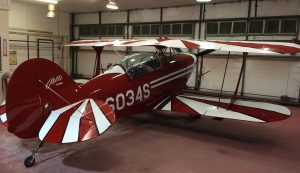 was beautiful. And in all fairness to Ray all of my concerns about the cost were unjustified. Sure, it wasn’t cheap, but it wasn’t outrageous by a long shot; I felt that he did a great job at a fair price. I couldn’t have been more pleased. I even got a souvenir.